Repetition
Cloister
The arcade converts walking into a countable circuit. Light advances across columns; rain enters at an angle; footsteps provide an imperfect clock. The cloister is not outside weather. It regularises exposure to it.
FOLIA SEPARATA · MMXXVI
CLAUSTRUM ET INSTRUMENTUM
Not a complete reconstruction, but four architectural devices for time, record, position, and local climate.
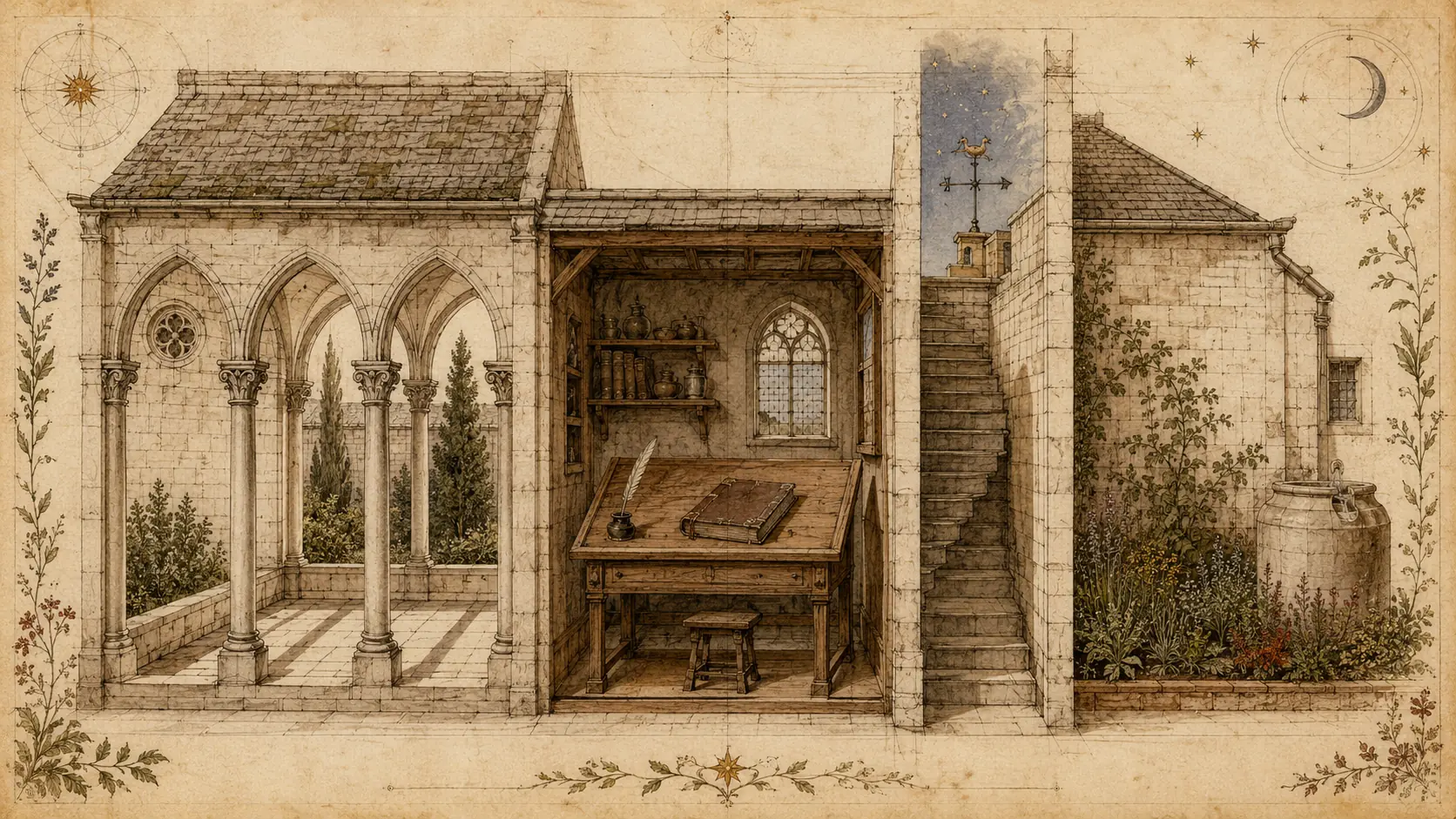
The arcade converts walking into a countable circuit. Light advances across columns; rain enters at an angle; footsteps provide an imperfect clock. The cloister is not outside weather. It regularises exposure to it.
Observation becomes transmissible only after selection. Ink fixes a statement while the omitted conditions remain in the margin. Scraping, correction, and gloss make revision visible instead of disguising it as certainty.
A stair changes horizon, wind exposure, and the relation between instrument and obstruction. Elevation is not spiritual by itself. It is a controlled alteration of the observer’s position.
Wall, aspect, soil moisture, shade, and stored rain establish a small climate. The plant is both organism and index: growth integrates conditions that no single reading preserves.
A DAY OF OBSERVATION
The building does not contemplate. It distributes bodies, light, water, silence, and repeated work. Contemplation occurs within that distribution.