Convection
Warm, buoyant air rises; cooler, denser air may replace it. In the body, no atmospheric cell is reproduced: heat is redistributed by blood flow and lost at the skin.
Similarity of transport is useful. Identity of mechanism is false.FOLIA SEPARATA · MMXXVI
CORPUS SUB AERE · RESEARCH LEAF
A scientific account first; a Hermetic correspondence second; the boundary between them kept visible.
A NOTE AGAINST CONFUSION
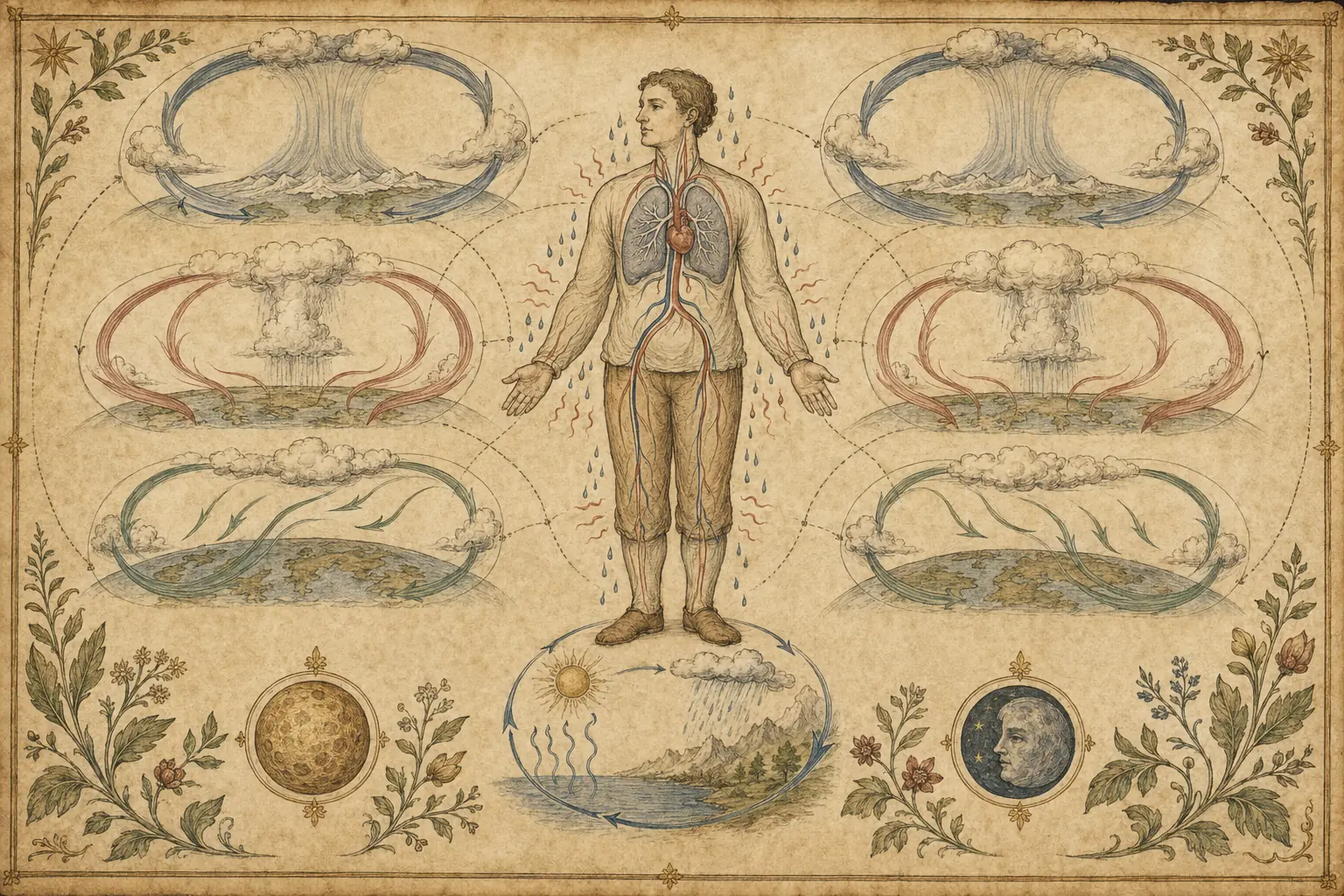
Atmospheric circulation redistributes heat, moisture, momentum and trace substances. The human body regulates temperature through circulation, sweating, behaviour and exchange with its surroundings. Both systems contain flows and feedbacks; that formal resemblance is the beginning of a question, never its proof.
Warm, buoyant air rises; cooler, denser air may replace it. In the body, no atmospheric cell is reproduced: heat is redistributed by blood flow and lost at the skin.
Similarity of transport is useful. Identity of mechanism is false.Sweat removes heat when liquid water changes phase at the skin. High humidity reduces the vapour-pressure gradient and can make evaporation less effective.
Humidity does not enter the body as an element; it alters a physical route of heat loss.The body exchanges radiant energy with surrounding surfaces and sunlight. Air temperature alone therefore cannot describe total heat strain.
Sun is an energy source, not a diagnosis or temperament.Light and darkness help entrain biological timing. Misalignment and sleep loss can impair alertness and performance.
A planetary sign may index time; it does not replace chronobiology.Repeated heat exposure can improve sweating efficiency, stabilize circulation, lower core temperature and reduce heart rate at a given workload.
Adaptation is gradual, individual and reversible—not an initiation or moral achievement.Temperature, humidity, wind, radiation, activity, clothing and health condition jointly shape exposure. A disciplined record separates what was measured from what was inferred.
Correspondence begins only after variables are named.THE GREATER CIRCULATION
Unequal heating and planetary rotation create broad patterns. The Hadley circulation is thermally direct in the tropics; the mid-latitude Ferrel cell is a statistical, eddy-driven construction; the polar cell is again thermally direct. Land, ocean, topography and transient weather add the irregular detail that a zonal diagram omits.
Surface winds help drive ocean currents. Coastline, bathymetry, rotation, temperature and salinity then redirect water, producing gyres, boundary currents, sinking and upwelling.
THE LESSER REGULATION
Heat strain depends on more than air temperature. Humidity, radiant heat, air movement, clothing, metabolic work, hydration and acclimatization alter whether the body can shed heat. Sweat cools through evaporation; when the surrounding air is moist, that route becomes less effective.
The body’s response is not a weather oracle. It is a situated physiological record whose interpretation requires context, repetition and care.
SOURCES · READ BEYOND THE CODEX
External links are a reading desk, not reproduced material. The manuscript plate and all explanatory prose on this page were newly made for the atlas.